Logos Testnet v0.2: From Convergence to Architectural Readiness
Hardening foundational protocols and bringing core privacy components online.
Nasrudin


On 30 June, Logos Testnet v0.2 went live to the operators already running nodes across the network. It has spent the weeks since being tested and hardened under real conditions. Now we are opening it up, bringing more people in to test the modules, run a node, and build.
For a module-by-module overview of what shipped in the latest update read our previous technical announcement. In this article, we would like to provide a high-level overview of what the goal of the testnet is, where it fits on the roadmap, and the next steps from here.
Testnet v0.1 was the convergence of the Logos stack. It proved that messaging, storage and consensus could be brought together and made to work as one. v0.2 is about architectural readiness.
Testnet v0.2 deploys and hardens the core protocols of the modular stack, Logos Messaging, Logos Storage and Logos Blockchain, and brings the network's foundational privacy primitives online.
While still in the testnet phase, the stack is evolving into a usable, private-by-default network, with the first of its privacy and decentralisation features now live and being hardened.
For those ready to start experiencing these updates, install Logos Basecamp to run a node and begin testing the modules directly.
Hardening privacy with Blend
Logos Testnet v0.2 is where the first pieces of a private-by-default architecture start to fall into place.
The clearest example is the Blend Network, which pushes privacy past the transaction and into consensus itself.
Blend adds anonymity for block proposers, and together with Cryptarchia, it delivers the private proof-of-stake consensus protocol for the Logos blockchain. With Blend functioning as designed, the operators proposing blocks can no longer be picked out by anyone watching network traffic.
Node operators can now participate in the Blend network, helping to improve block proposer anonymity and secure the network.
Privacy now covers more than the contents of a transaction; it reaches the consensus process that secures the chain, moving Logos towards Private Proof-of-Stake.


With Blend now implemented, the Logos stack takes another step towards solving the privacy challenges involved in the supply chain of a blockchain transaction. Reliance on centralised servers and traceable routing protocols makes it impossible to transact without the risk of being identified. Blend brings the stack one step closer to achieving end-to-end privacy that goes far beyond cryptographic security.
The core modules have matured alongside Testnet v0.2, and are now all able to be run from within a Logos node. Logos Messaging offers a new delivery layer with a cleaner API for reliable message delivery. Logos Storage features several architectural improvements, including better NAT traversal which can be leveraged across the Logos stack
The documentation provides further insight on Logos modules, with specifications that describe each protocol implementation.
Interoperation and usability in practice
Testnet v0.2 also provides the functionality that allows sovereign zones on the Logos blockchain to knit together.
Token bridging, exposed through the Zone SDK, is the foundation for interoperation across sovereign Zones: the way assets and state move between independent execution environments, and the groundwork for an interoperable network of Zones.
Decentralised sequencing has also been delivered, allowing each Zone to order its own transactions without a central sequencer. This is ready to enable at a later stage of testing to make the network more resilient and independent.
The latest version of the Logos testnet also improves accessibility for users and developers. Every module now lives inside Logos Basecamp, a single, local-first application that bundles everything you need to use Logos.
This means all core aspects of the Logos stack can now be accessed from one desktop application rather than being wired together by hand. The Logos node can be run through Basecamp too, making it easy to join and participate in the testnet, or to contribute to its underlying privacy by running the Blend protocol.
Testnet v0.2 opens the door to external validators, making it easier than before for new operators to be onboarded to the Logos ecosystem.
Builders can work with the Logos stack today, and λ Prizes are awarded to developers for creating privacy-preserving applications underpinned by Logos infrastructure.
Start with the documentation, or run Basecamp.
What's next
Testnet v0.2 is the moment where the Logos stack is architecturally sound, laying a foundation for builders to start building privacy-preserving applications and for end-users to try them out. The pieces are in place, core privacy primitives are deployed, and the network is stable enough to experiment with and join as a node operator.
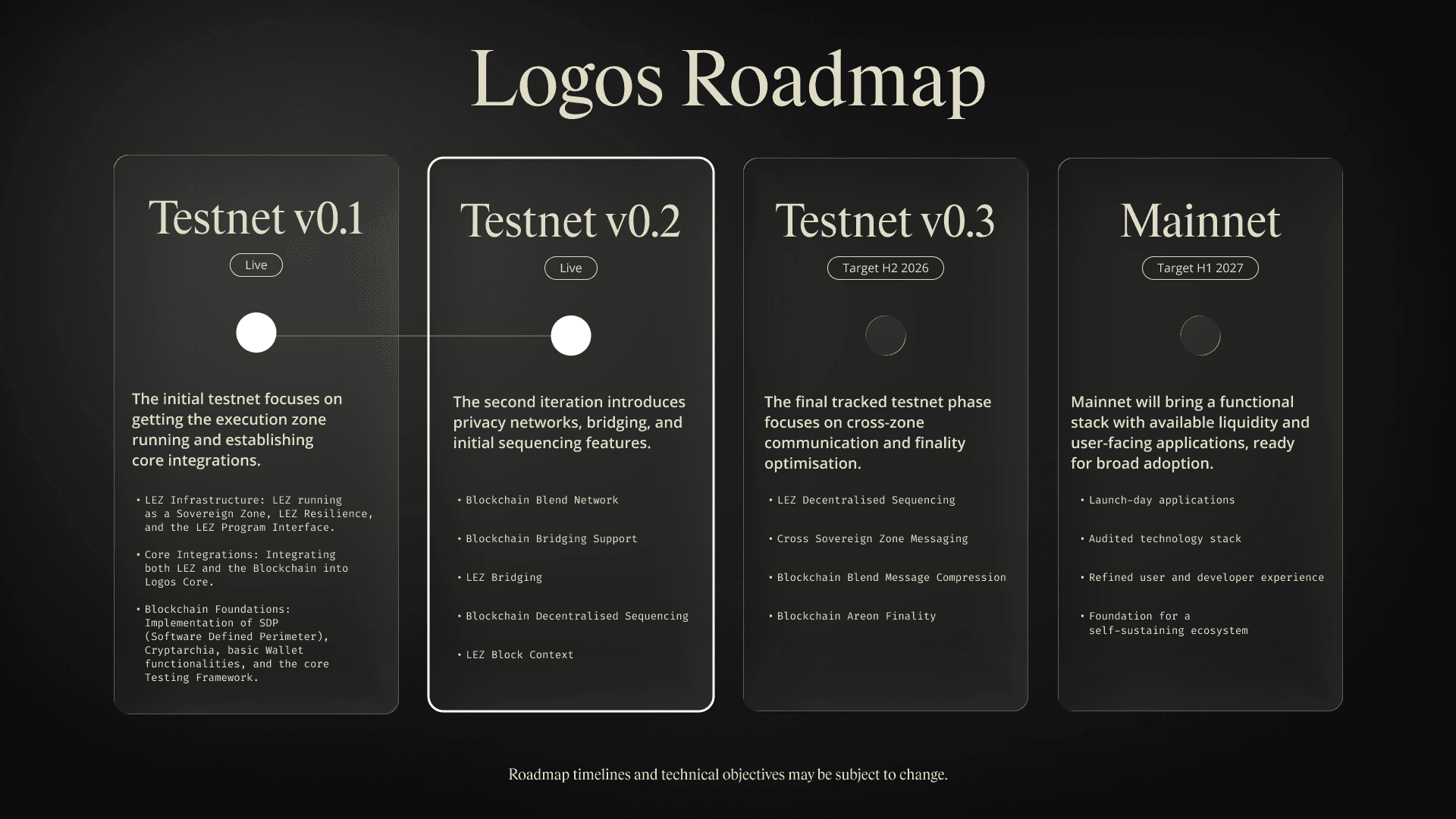
Work is continuing across all Logos modules as we progress towards Testnet v0.3, which will pave the way for an ecosystem to develop on top of the privacy-preserving, modular infrastructure.
There are a few ways to get involved with Logos Testnet v0.2:
- Run a node through Logos Basecamp and help test the network in the wild;
- Start building on Logos and explore λ Prizes to win prizes for solving challenges and developing applications;
- Or read the documentation for a more in-depth look at the foundational Logos infrastructure and modules.
Testnet v0.1 brought the pieces of Logos together into a unified technology stack. With Testnet v0.2, we have reached the stage where the architecture is ready to be expanded and built upon.
As we progress along the roadmap, we invite contributors to join our mission and to build on the human-centred technology stack that will chart a new course for society.
Build the parallel. Prove it in practice. Keep it human.
Discussion
Nasrudin
Nasrudin
Nasrudin