Basecamp in Testnet v0.2: The Local-First Launcher for Privacy-Preserving Applications
Basecamp in Logos Testnet v0.2 is easier to set up and features expanded capabilities.
Logos


Most software hands the user a client and keeps the infrastructure elsewhere. That is a reasonable trade, and it is how most applications work today, even those that focus on preserving user privacy.
But this also means the parts that matter most – where your keys live, where your traffic enters the network, who sees your queries before any of the cryptography applies – stay somewhere you cannot inspect.
Basecamp a return to local-first principles: the whole stack, node included, on hardware you control, installed the way any other application is installed but without needing to trust a third party.
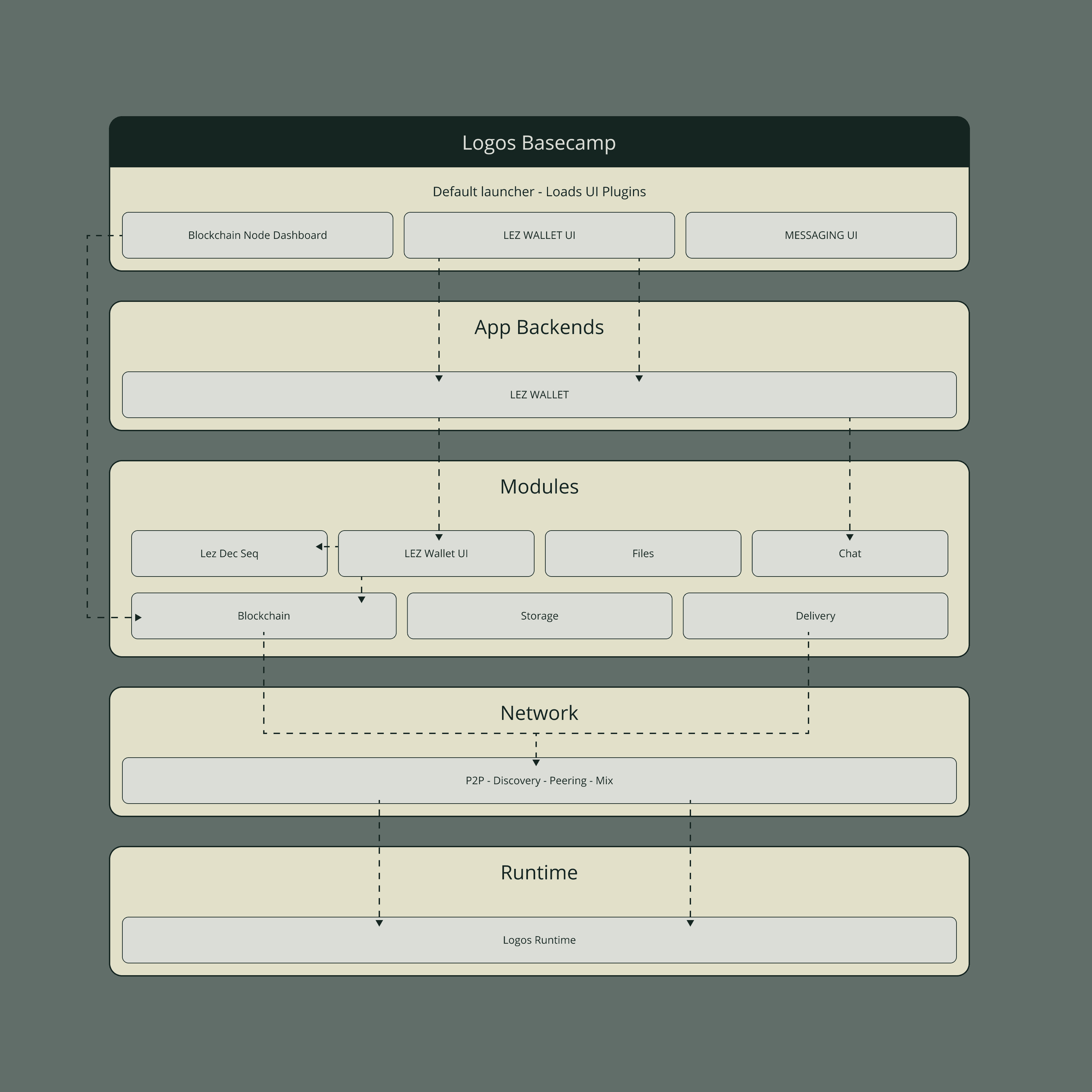
Basecamp is the desktop application that runs the Logos stack on your own machine. Modules including Blockchain, Delivery, Chat, LEZ, and Storage are all accessible through a single open-source installation, along with the apps built on top of them and the tools to publish and install more.
It is an open and accessible interface for people who use Logos and the applications built on top of it, such as private p2p chat, atomic swaps, or a blockchain wallet.
In Testnet v0.2, getting Basecamp installed takes zero terminal windows on macOS and a single chmod +x on Linux.
Download and install Basecamp at logos.co/basecamp.
Watch a video walkthrough of installing Basecamp.
Why a desktop application
Making Basecamp a desktop distribution is a deliberate architectural decision rather than a nostalgic one.
Consider what running an ordinary application means today. It does not run on your computer so much as on a server you cannot see, rendered through a window you do not control. The operator of that application decides what you may do, records that you did it, and reserves the right to change the terms tomorrow.
The browser is enemy territory for privacy software - it exposes you to fingerprinting, extension spyware, the fact that every “decentralised” web app still loads its code from someone’s server on every visit.
You might object that Basecamp comes from someone’s server too, and you’d be right: it’s a binary off a release page, and updates re-trust that repository each time you take one. The difference is you take them explicitly, when you choose, and every launch in between runs code already on your disk.
By comparison, a web application re-trusts its server on every page load, and a server compromised this morning rewrites the application you run this afternoon.
Local-first also means your node, your keys, and your data live on hardware you control. A message or transaction sent from Basecamp enters the peer-to-peer network from your own machine, as a peer. Other nodes relay the traffic, and on testnet the first hop is bootstrap infrastructure the project runs.
What no relay sees is the gateway view. A hosted RPC provider reads your queries in the clear and logs which address asked for what, and no privacy layer further down the stack can undo that record. Basecamp is where a transaction's supply chain begins, and an entry at step zero tying identity to intent stays tied however well the later stages mix.
One shell for all modules, rather than one app per module, is the other half of the design. The obvious alternative is separate apps sharing a local daemon, which is how half of crypto works today (a wallet pointed at your node). That gets you shared infrastructure but leaves every app shipping its own updater, its own authentication, and its own opinion about module versions.
The shell solves those once, and it makes composition a first-class process: the AMM app runs on the LEZ module, the filesharing app runs on Storage, and modules call each other’s APIs through one runtime that permissions the calls (Core’s token exchange and caller allow lists can restrict module API access).

What is in v0.2
v0.1 packaged the stack with alpha interfaces, delivering initial proof-of-concepts for user applications. Chat required swapping key bundles out of band, and mix routing lived in a separate demo application. v0.2 is where Basecamp becomes something more usable while still remaining experimental and under ongoing early development.
With the latest version of the Logos Testnet, Basecamp now offers:
- Chat: End-to-end encrypted messaging on de-MLS groups, with 1:1 conversations rebuilt as two-person groups, which is what enables multi-device. Mix routing optional.
- File sharing: Storing and retrieving files through Logos Storage.
- LEZ wallet: Native transfers including public-to-private and private-to-public moves, plus creating and transferring custom tokens in both states.
- Explorers and applications: An LEZ explorer, a blockchain dashboard, and an AMM running against a real DEX program deployed on the LEZ, alongside oracle and token programs.
This is testnet software throughout: it has test tokens, rough edges, and things that will break. Every item above is available to try from Basecamp today.
This video provides an overview of what Basecamp is and how it works.
The App Manager and refreshed Package Manager are what make the rest of it extensible. Applications install, update and uninstall from release repositories through the interface, with proper handling of upgrade state.
Combined with the standard module publishing path that landed in Logos Core, the third-party route is now complete end to end: a developer publishes a module to a release index, and a user adds that repository and installs from it. There is no centralised app store and no gatekeeper deciding what qualifies.
Security through modularity and isolation
An open publishing model means Basecamp will run code written by strangers. Much of the v0.2 security work is aimed there.
UI applications now load their Qt plugins in separate processes, so an application that crashes, or misbehaves deliberately cannot take the shell or its neighbours down with it. The QML sandbox has been hardened and auth-token handling for UI backends corrected. That pairs with the runtime work in Logos Core, where token exchange and caller allow lists restrict which modules can reach which APIs, giving the same boundary at two levels: process isolation for interface code, API restriction for modules.
This is the cost of an open application model. There is no option to skip building isolation and fall back on review-and-ban, so therefore the isolation has to be better than a walled garden's rather than merely comparable.
It is worth being clear about maturity. This is testnet software, and the sandbox has not survived the decade of adversarial attention that browsers have. What can be said is that the threat model is the honest one — assume applications are hostile — and that the v0.2 release notes are boundary-first: process isolation, sandbox hardening, auth-token fixes, API access restrictions.
The changelog is public and readers can judge where the effort went.
The overview walkthrough includes a moment where Doom runs inside Basecamp, which demonstrates that the application model is not limited to wallets and explorers. The isolation work above is what keeps something like that from touching anything else on the system.
Running a node
Basecamp is also the front door for infrastructure. Running a node used to mean the CLI, which still works and remains the serious operator path in headless daemon mode. Basecamp now runs and manages node modules directly, with the OpenMetrics module exposing metrics to Prometheus-compatible tooling.
Will click-to-run laptop nodes carry a network by themselves? No; serious operators still need uptime and bandwidth, and that’s what the daemon path is for. But a permissionless network needs a steady supply of people who move from curious to operating, and that supply is larger among those who install applications than those who survive a README.
Running a node is the most direct way to support the network. You don’t need to be a developer or an infrastructure engineer, and Basecamp reduces it to something achievable in minutes.
Each node strengthens the early blockchain network, adds weight to the emerging stack, and adds one more peer to a system built on the premise that no single party should hold the whole of it. It is the smallest unit of sovereignty over a network you depend on, and the easiest one to claim.
For builders, λ Prizes offer incentives for shipping modules and applications on the Logos stack, accelerating real, shipped applications that preserve user privacy.
Get involved
To start using Logos:
Download and install Basecamp at logos.co/basecamp, and run the whole stack on your own machine.
Run a node through the Basecamp blockchain module, or a headless node through the CLI, and help test the network in the wild.
Read the documentation at docs.logos.co/basecamp for more information on the modules and node operation.
In this phase of the testnet, reports of issues and friction are more valuable than praise. Install Basecamp and experiment with Testnet v0.2, and flag where you get stuck, where applications and infrastructure breaks – all of it helps to harden the stack.
Build the parallel. Prove it in practice. Keep it human.
Discussion
Logos
Logos
Logos
Logos
Logos
Logos
Logos
Logos
Logos
Logos