Logos Blockchain in Testnet v0.2: Privacy Reaches Consensus
Testnet v0.2 brings privacy to the consensus layer of the Logos blockchain.
Dr. Corey Petty


For the better part of a decade, this industry has bolted privacy onto blockchains. Shielded pools here, a privacy L2 there, always at the execution layer, always after the fact. Those efforts leak in plenty of places — in anonymity sets too small to hide amongst, in opt-in privacy nobody opts into — and the networking layer can expose all of them.
Fixes that have actually shipped to improve privacy, Dandelion++ and running a node behind Tor, protect a transaction on its way into the network. Nothing shipped protects the people keeping the chain alive. A transaction can be wrapped in the best zero-knowledge cryptography available, and the moment a node broadcasts to the network, an observer starts correlating.
To understand the challenge of achieving complete privacy, it helps to treat a transaction as a supply chain.
Value only moves at settlement, but getting there runs through discovery, diligence, negotiation, contracting, ordering, settlement, and enforcement, and every one of those stages is its own attack surface. Privacy that holds at one stage and gives way at the next is not privacy at all: any protection is only as strong as its weakest link.
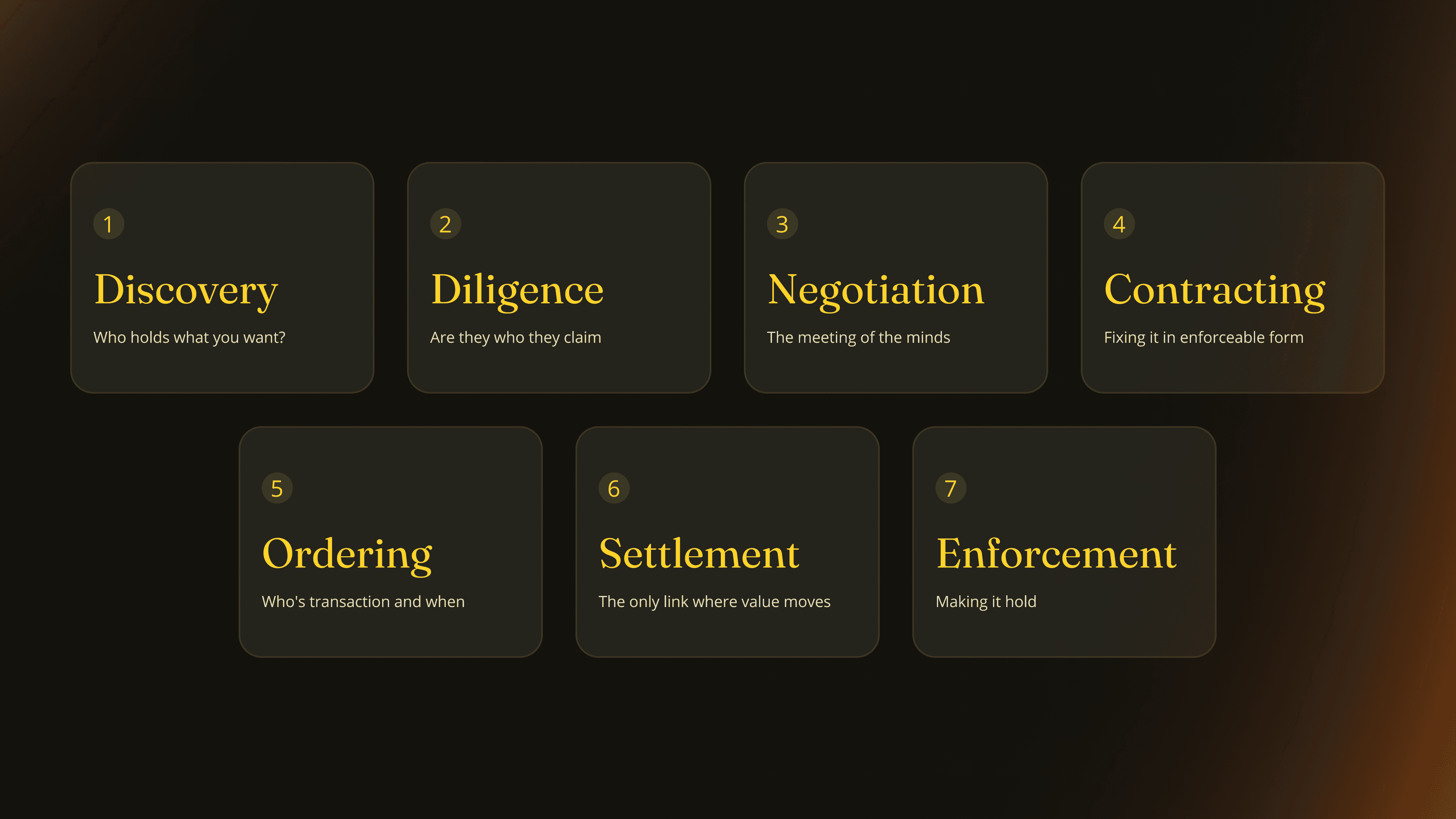
End-to-end privacy is the design philosophy behind the Logos stack, which means closing the links nobody else will.
With the launch of Testnet v0.2, Logos delivers the protocols that deliver privacy at the level of consensus. Cryptarchia makes leader election private, Blend makes the broadcast that follows it anonymous, base-layer sequencing decentralises ordering, and bridging carries assets between zones securely.
The leak at consensus
Proof-of-Stake has a structural privacy defect. Someone has to propose each block, and proposing means broadcasting to the network. Broadcast from your own node and any observer can tie the proposal to your IP. From there, they determine your identity if they care enough, and an estimate of your stake over time, because leaders are selected proportional to stake.
Watch long enough and the chain's validator set becomes a public list of who holds what and where they live on the network.
This is not a problem that can be solved by making a transaction more cryptographically secure. A transaction can be perfectly shielded and this still happens, because it is the infrastructure operators being deanonymised, not the users or their transaction data.
A validator who can be identified can be targeted: DoS'd right before their slot, coerced, or just catalogued. And it lands at the link in the supply chain everything else depends on, because a transaction is only as private as the chain that produced it.
This is why there is extensive research into private leader election, a field with real literature behind it, and the Cryptarchia consensus used by Logos emerges from this work.
Cryptarchia's leader selection happens privately: a node proves it won a slot without announcing who it is. But this only solves half the problem - network traffic must also be anonymised to realise private Proof-of-Stake.
Blend and proposer privacy
The Blend Network, now live on Logos Testnet v0.2, is the second piece of the puzzle. It is an anonymous broadcast layer purpose-built for block proposals, and it deliberately does not work like a general-purpose mixnet.
A proposer wraps its block in layers of encryption, and the message floods to every Blend node rather than snaking down a single path. Each node that can peel a layer does so, sits on the message for a random delay, and passes it on, with cover traffic filling the gaps so real proposals have a crowd to disappear into.
Nobody watching can tell which hop a message is on, which node it is ultimately for, or whether it is a proposal at all. The design goal is to make linking a block to the machine that produced it far too expensive for even the most capable of adversaries to deanonymise it through monitoring network traffic.

Together, Cryptarchia solves private election and Blend solves privacy-preserving broadcasting, securing the identities of block proposers and validators and making the settlement layer private enough for the rest of the chain to safely lean on.
The launch of Blend in Testnet v0.2 marks a major part of the private Proof-of-Stake implementation, the scope of which also covers spam protection, redundancy in block proposals, and censorship resistance against malicious broadcasters, so that a relay that decides to sit on a block does not get to silence it.
How much of that hardening holds up under real traffic is one of the things v0.2 exists to find out.
The tradeoffs are real, so they are worth being upfront about here. Routing proposals through Blend adds latency, and added latency in a consensus protocol means more forking pressure on Cryptarchia. The leadership proofs themselves take time to generate, and that time lands on the same critical path. Blend parameters need careful tuning to keep the system stable, and that tuning is exactly the kind of thing testnets exist to shake out. Node operators who see fork behaviour worth reporting should report it; that is useful data that can help to harden the protocol.
It is also important to note that this is a fully permissionless network. Anyone can run a validator. There is no whitelist, no foundation-approved set, which raises the stakes for proposer privacy, because a permissionless validator set has no governance chokepoint to attack, and that makes the network layer the most attractive surface left.
Zones, bridging, and sequencing
The second big v0.2 story is about execution, and about the ordering link in the supply chain: whose transaction goes through, and when. Logos separates agreement from execution: the base layer settles, and Zones execute. The foundational Zone is the Logos Execution Zone, which is the primary execution layer for applications built on the Logos stack.
Rollup-style architectures have a sequencer problem: one operator orders all transactions, and decentralising it stays perpetually next on the list. Shared-sequencer projects exist, but the dominant rollups holding real assets still run a single sequencer. An operator who controls ordering controls one of the stages a transaction has to pass through, whatever the cryptography does at settlement.
The Logos blockchain’s answer, shipped in v0.2 as a working PoC through the Zone SDK, is to make the base layer do the coordination. Zones do not run their own consensus. Sequencers register on the blockchain, the blockchain enforces the sequencer schedule, and channels — the on-chain lanes a Zone writes its data through — support multiple writers with built-in conflict management. Sequencers can join and leave, and the design tolerates misbehaving ones.
A Zone gets decentralised sequencing without touching p2p networking or consensus protocols, because that complexity already lives one layer down, where it is amortised across every Zone at once.
This robust design and abstraction of complexity is not free, either: coordinating through the base layer means inheriting its latency, and there is a risk that decentralised sequencing can cut throughput and invite invalid messages into channels. What happens to Zones when the base layer is the bottleneck is a question any rollup engineer would ask first, and there is no tested answer yet.
Still, the division of labour is the design rationale. The base layer's job is to be the thing everyone can lean on: for settlement, for ordering, for the sequencer schedule. The job of Zones is to be good at applications.
v0.2 also ships bridging between the base layer and Zones: deposits into a Zone's channel are permissionless, withdrawals are threshold-signed by the Zone's sequencers, all exposed through the Zone SDK.
If you would like to experiment with moving assets between Zones and the Logos blockchain, check out the tutorial in the Logos documentation for more information.
Running a node
In v0.1 the blockchain was the primary focus of development with its own lifecycle. The point of a modular stack, however, is that nothing is a unitary proposition, and v0.2 is where Logos nodes can run multiple components of the stack.
Running the blockchain node is now the same operation as running storage or messaging: through Logos Core and Basecamp, with consolidated metrics across all of it.
Instructions for running a node are available here.
In Testnet v0.2, the chain a transaction settles on is now secured by validators who do not have to expose their identity, or much about their stake, to do the securing. That is operator privacy rather than transaction privacy, and it closes a link beyond simple securing the cryptography behind a transaction.
To get involved with Logos Testnet v0.2:
- Run a node through Logos Basecamp and help test the network in the wild;
- Start building on Logos and explore λ Prizes to win prizes for solving challenges and developing applications;
- Or read the documentation for a more in-depth look at the foundational Logos infrastructure and modules.
Build the parallel. Prove it in practice. Keep it human.
Discussion
Dr. Corey Petty
Dr. Corey Petty
Dr. Corey Petty
Dr. Corey Petty
Dr. Corey Petty
Dr. Corey Petty
Dr. Corey Petty