Public Debt Interest: Past Excesses and Their Chokehold on Our Future
Debt interest is a claim on all of our futures that we didn’t ask for and never voted on
Bathang


In democratic nations, there’s a ritual that unfolds every few years. Those hoping to run the show engage in a hugely expensive popularity contest in which they try to convince the rest of us that they know how best to spend public funds. They boast their superior stances on tax rates, welfare budgets, healthcare funding, defence commitments, infrastructure plans, pensions, and so on, in the hope that enough of us find their proposal the most attractive, or at least more agreeable than the alternatives.
But there’s a share of government spending that has little presence on the campaign trail. It takes up no space in political pamphlets or manifestos. That’s because it’s non-discretionary, non-negotiable, and produces almost nothing directly useful for the public. That spend is debt interest, and in many nations, it’s swallowing an ever-greater share of public funds.
Government borrowing isn’t all bad, of course. A well-spent loan can drive growth, increase GDP, and improve living standards. The issue is that political incentives have made borrowing the most attractive way for governments to fund almost everything. Debt has become the default.
This borrowing isn’t free. The money itself needs to be repaid, and until it is, loans need to be serviced through interest payments. This creates inescapable obligations, making debt dependence inevitable and placing indebted nations (i.e. all nations) and everyone residing in them (i.e. all of us) in a precarious position.
Under the current system, debt is not merely a sparingly used tool but a structural (and often constraining) permanent fixture.
An inflating expense
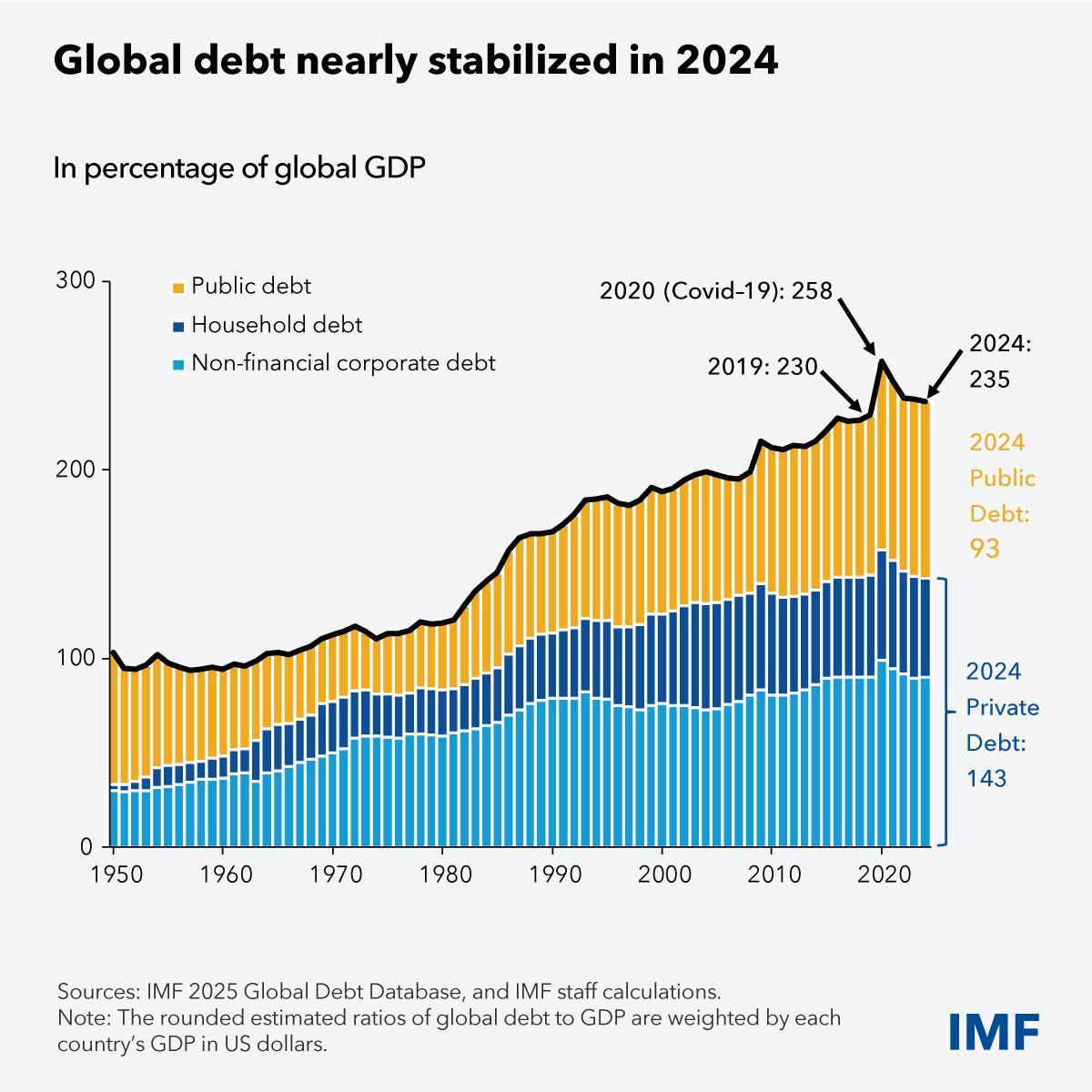
The IMF estimates that the planet's combined public debt is around $100 trillion, or around 93% of global GDP. Outside of a tiny number of highly resourced, small economies, every nation on earth has at least some public debt. The most indebted include the USA ($39 trillion), China ($21 trillion), Germany ($3.6 trillion), and the UK ($4.6 trillion).

Borrowing itself isn’t necessarily bad. Taking a loan to invest in transport infrastructure, for example, can boost economic output. If that infrastructure connects more individuals to employment opportunities, it can reduce the number of people out of work, bolstering tax revenue and lowering unemployment benefit expenditures.
Sometimes borrowing occurs due to unexpected crises, such as war, a financial collapse, or a pandemic. During COVID-19, many governments borrowed heavily to keep businesses alive, support household incomes, and prevent mass unemployment. In moments like these, debt can be seen as an essential tool to prevent absolute economic meltdown.
But debt interest is different. It’s not a bridge, a railway, a hospital, an energy grid, or an emergency support scheme. It’s the recurring cost of maintaining yesterday’s spending.
Lending money, even to governments, carries risk. Nation states are quite capable of default, after all. Therefore, lenders need an incentive, and that incentive is the interest they receive for holding government bonds. From the government’s perspective, those payments are the cost of credibility. Stable-low risk countries, like Japan or Germany, can offer low yields on government bonds. Conversely, less stable countries, like Russia, Turkey, or Brazil, must offer higher yields to compensate for the higher risk of default, inflation spikes, currency depreciation, and other factors that might discourage those seeking reliable returns.
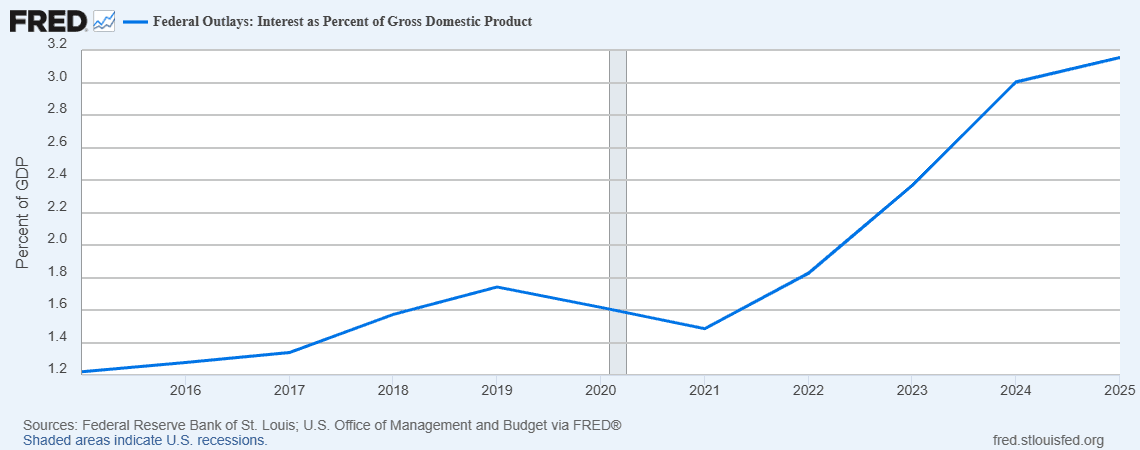
Even in relatively stable nations, the accumulated cost of servicing debt quickly mounts if the government continues to borrow. The UK, for example, is set to spend £114 billion on debt interest payments alone in 2026. The figure dwarfs the £62.2 billion it’s projected to spend on defence and the £37 billion on housing benefits. In the US, the planet's most indebted nation, interest payments are expected to top $1.04 trillion this year, which is around 14% of the entire federal budget and around 3.2% of US GDP in 2025.

That money doesn’t disappear into a void. It goes to bondholders: pension funds, banks, insurers, foreign governments, investment funds, central banks, and private investors. From the public’s perspective, however, it’s money that isn’t being spent on tax cuts, healthcare, policing, defence, infrastructure, housing, or welfare.
Therefore, every budget begins with inherited obligations; a significant share of public funds is already spoken for.
How debt became the default
Public debt solves short-term political problems in a way that is less immediately painful than the other available options. Taxation and spending cuts are unpopular. Crises require immediate liquidity. And voters want public services, security, pensions, welfare, and infrastructure.
Borrowing allows governments to distribute the burden of what they spend today across future generations of taxpayers, many of whom are too young to vote or not yet born. It’s politically convenient because the consequences are only felt years or decades later, long after the public has forgotten the current administration’s excessive spending. It’ll be the responsibility of a future government to force the public to swallow a bitter pill later. So, they’re incentivised to kick the proverbial can down the road.
Modern financial markets also make sovereign debt structurally important. Government bonds are considered among the safest assets in the financial system. They sit on bank balance sheets, anchor pension portfolios, provide collateral in markets, and serve as a tool for monetary policy.
This creates a feedback loop. Governments need debt markets to fund themselves. Financial institutions need government debt as a safe asset. Central banks need government bond markets to transmit monetary policy. The entire system becomes organised around the assumption that sovereign debt will remain credible, liquid, and politically protected.
Through these systemic connections, debt becomes a pillar of the regime.
Tightening flexibility
Elections, in theory, allow citizens to choose a different path forward. Or, at least choose between those promising an alternative. They can vote for whichever party claims to deliver higher spending, lower taxes, stronger defence, less welfare, better infrastructure, tighter borders, looser regulation, or any number of competing priorities. But the larger the stock of debt becomes, and the larger the interest bill attached to it, the less room any government has to manoeuvre.
Once debt interest consumes enough of the pool of public funds, governments face a narrow menu of unpleasant choices. They can raise taxes, cut spending, borrow more, tolerate higher inflation, pressure central banks to keep borrowing costs low, or attempt some combination of the five. Each of these options carries some trade off.
Higher taxes reduce private economic freedom. Spending cuts create political anger and can damage public services. Inflation erodes purchasing power and transfers wealth from savers to debtors. Artificially suppressed interest rates distort capital allocation and punish those who rely on savings income. And more borrowing compounds the problem that forced the hard choice in the first place. Regardless of the decision made, some cohort of voters (or political donors) gets stung and feels unrepresented by their supposed representatives.
As the debt dependency deepens, preserving bond market stability becomes a critical consideration in any spending decision. Suddenly, governments start appeasing their central bank, and public preferences take a back seat. There isn’t some mysterious, tyrannical force manifesting this outcome; it’s simply a matter of incentives.
Debt-incentivised centralisation
Predictable revenue is always important for states. However, the more indebted a nation, the more crucial this predictability becomes. The state becomes more obsessed than ever with making sure that every possible penny it can lay claim to finds its way to them.
The result is heightened financial surveillance, including more stringent reporting requirements, lower thresholds for perfectly legal cash payments, attacks on privacy-preserving financial technologies, and hostility towards anything that might be considered as allowing individuals to opt out of financial visibility.
This doesn’t mean every reporting rule is sinister, or that every tax authority is tyrannical – although there is certainly an argument for the latter. States need revenue to function. However, a government that must constantly reassure creditors will naturally prefer a population whose assets, income, transactions, and capital movements are visible and enforceable.
When the average person thinks about attacks on freedom, their mind immediately goes to dramatic rulings enforced by authoritarian governments. Perhaps more concerning because of its diminished visibility, however, is the chipping away at freedoms that occurs more regularly and covertly through administrative necessity.
Herein lies much of the appeal of central bank digital currencies. Depending on their implementation, CBDCs could fully automate tax revenue collection. Consequently, governments could reduce spending on agencies such as the IRS in the US and HMRC in the UK. The upkeep of these agencies costs the public billions of dollars every year, money that could be used to reduce deficits, debt, and interest payment burdens.
However, this fully automated tax collection machine would also enable the most efficient social control mechanisms the world has ever known. Monitoring what citizens are spending their money on becomes trivial, and so does excluding individuals from specific purchases, or even blacklisting them from the economy entirely.
While this might sound like something from a dystopian science fiction novel, the technology is already available, trials of CBDC have been underway for years by this point, and it only takes one policy or implementation change to turn what was initially sold as a tool to make everyday people’s lives easier into a system for absolute control.
Debt interest and systemic self-preservation
Our dependence on debt has also helped to enshrine the positions of some of the most powerful institutions on earth. Banks, pension funds, and insurers all hold government bonds, while central banks buy and sell bonds. Investors and regulators consider them as safe assets, and they’re used as collateral across financial markets. From pensioners to international investment banks, the entire system and everyone in it is highly dependent on government debt. Debt market stability is, therefore, everyone’s problem.
If a government defaults on its debt, investors obviously feel pain. But the damage spreads much further. Pension funds are hit, weakening currencies impact import markets, the cost of borrowing gets prohibitively expensive for everyone, public services collapse, and brutal austerity measures become the only viable option.
This creates a system that resists change and prioritises stability over the will of the people. Large public debt completely shifts the state’s priorities, binding policy to the expectations of creditors rather than those who elected the current batch of public representatives. In the process, it transforms future taxpayers into guarantors of past decisions.
Debt dependency stifling freedom
Every dollar or pound spent servicing yesterday’s spending represents funds that cannot be used to improve the lives of people today. In the poorest nations, interest payments exceed the entire budget allocation to health or education. Yesterday’s spending is quite explicitly depriving current generations of opportunities for a more comfortable life.
In more developed countries, the effects are less dramatic but still corrosive. Debt interest narrows fiscal choice. It increases the pressure for taxation. It widens inequality by making inflationary escape routes more attractive. Wage earners and savers suffer at the expense of asset holders, who are typically disproportionately richer anyway. It entrenches the role of central banks, whose leaders were never elected and are highly incentivised to act corruptly. It invites attacks on privacy-preserving tools and, consequently, everyone’s freedoms.
We’re obviously not saying borrowing should never happen. A state that refused to take on debt would be extremely vulnerable to unforeseen emergencies and unable to capitalise on opportunities as they arise. The issue is whether societies understand the long-term trade-offs created when borrowing becomes routine and preserving access to debt markets becomes structurally unavoidable.
Logos Circle / London is actively working to educate the UK public about the consequences of national debt and the associated interest payments, so we can change the path we’re on. The technologies we’re building enable unprecedented financial and societal experimentation. Empowered with such tools, we can defend our own freedoms and develop public services on our own terms, not have them dictated to us by a class of all-powerful institutions we never elected and never asked to rule our lives.
Logos builds infrastructure to revitalise civil society. We need developers, designers, writers, and activists to help shape it.
Discussion
Jarrad Hope
G IRL
Peter Ludlow
Jarrad Hope
Bathang
Bathang
Bathang
Bathang
Bathang
Bathang